Pages

Showing posts with label Maths. Show all posts

Wednesday, 22 May 2019

Exploring BEDMAS by Lydia

πŸ“˜BEDMAS - The Order of OperationsπŸ“˜
IALT: Blog about Algebraic Computations

Talofa Lava and welcome to my blog! Yesterday for Maths Room 9, we learned about BEDMAS which is an acronym for:

Image result for bedmas
BEDMAS is a Mathematical Operation that you would use to solve an equation. Here is an example of a BEDMAS question: 

6 - ( 9 - 2) + 3 x 6


Before learning about BEDMAS I always thought that you simply solve the question in the order that it is presented. But then I discovered the BEDMAS principles and how you should apply it when solving equations. This is how I would normally solve the question before I learned about BEDMAS:

6 - 9

But since I couldn't do that I would get stuck in the equation and the answer would've been wrong. After learning about BEDMAS and what it is, this is how I would solve the problem:
6 - ( 9 - 2) + 3 x 6
Simplify:
6 - 7 + 3x6
6 - 7 + 18
6 - 7 + 18
24 - 7 
= 17 
Image result for maths gif
--------------------------------------------------------------------------
I really enjoy learning about BEDMAS because it teaches me how to solve various equations using multiple operations.    I can't wait to learn more about BEDMAS!
Question of the blog: Have you ever learned about BEDMAS? How has it helped you in your Mathematical Learning?

Thank you for reading this blog! Make sure to give me some POSITIVE feedback and feedforward! Bye :)

Wednesday, 27 March 2019

Exploring Algebraic Equations by Lydia Bloomfield

πŸ“˜➕Algebra - Learning Something New in MATHS!πŸ“˜
IALT: Solve an Algebraic Equations.

Malo E Lelei and welcome back to my blog! Today in Room 9 for Maths, I learned how to solve an Algebraic equation.
Image result for algebra gif


Related image
I asked Mr Janse to give me ANY equation and I thought he was going ask, "34 x 14" or "128 x 6" But instead he said, "2x + 14 = 80" and my job was to find the value of the 'x'. On my first attempt to solve this equation, I divided 80÷14 and Mr Janse said that's not quite correct yet. I was really confused so Mr Janse made it a bit easier and said, "Okay, the value of the 'x' is 33. Find out how and why?" This made it a lot easier and I looked at the equation and said the x is 33 because 33 x 2 = 66 and 66 + 14 = 80!" I was really happy that I had found the answer and Mr Janse then taught me how to formulate it. 

This is how you would write the answer to the equation:

There is supposed to be a dot/space between the 2 and 'x'. 
This looks like:
2.x
The dot means to multiply so basically you're multiplying                                         the 2 by the 'x'.

2.x + 14 = 80
What we're first trying to do is get rid of the 14 so to get rid of the 14 we have to subtract 14 away from 14 which equals 0
(14-14=0)
Then we have to do the same with the 80. For example:
2x = 80 - 14
When Mr Jay explained how to solve this he always wrote '2x =' before he would continue. This looks like:
2x = 66
Which also means 80-14=66
Next you have to divide 66÷2 which is the number before the x. This should look like:
2x = 66÷2
And then the answer will be the value of the 'x'.
x = 33
Wait! We're not done yet. The 33 will the become the substitute of the 'x' and this will make the equation:
2.33 + 14 = 80
Because:
2x33=66
66+14=80

Image result for akoI am really glad I learned how to solve Algebraic Equations and I am very happy that I was able to show Ako and teach Hevani and Grace how to solve these questions! One thing I need to work on is explaining WHY I have to always write 2x=, and WHAT does it do to the equation, but this just shows how much more I have to learn! 
--------------------------------------------------------------------------
I can't wait to learn more about Algebra! I hope you have learned something!
QOB: 
Have you ever learned about Algebra? 
What is your favourite subject in school?

Thank you for reading this blog! Bye :)

Monday, 25 March 2019

Multiplying by Round and Compensating by Grace

✏️πŸ”ƒ!Maths - Rounding and Compencating!πŸ”ƒ✏️
WALT: Multiply using tidy numbers, rounding and compencating.

Bonjour and greetings to you all! Welcome to my blog!

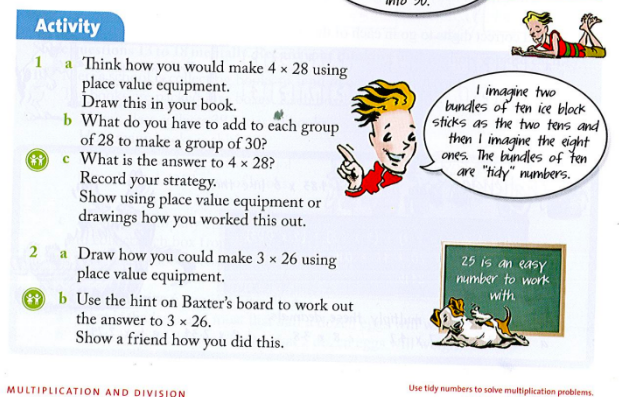
Throughout this term for Maths I have learnt how to use rounding and compensating. This strategy was new to me so I was looking forward to learn more about it. We started by multiplying one digit number to a 2 digit number. With rounding you have to remember that when you are rounding up you compensate by subtracting the number and you do the same when you are rounding it down you compensate by adding. That is why it is important that you know your basic facts really well because once you know them it would help you even more in your maths.


Here is an example:

3 x 78= 234
  ( 80 x 3 - 3 x 2)
( 240 - 6)
=  234

So what I have done here is that I have rounded  78 to its nearest 10 which is 80 and to get to 80 I added 2. Then I multiplied 80 by 3 which equals 240. I know this because 8 x 3 = 24 , 24 x 10 = 240. The next step is that you multiplied 3 by 2. The reason why I did this is that whenever you compensating a number by adding and subtract and you are multiplying, you then multiply that number. After that you subtract the total that you got 240 and 6. Which equals 234. Like what I have said before when you are round up you then have to subtract.

I have enjoyed learning this method and knowing how easy it is to use it. Now I can use this to solve complicated questions/equations rather than using algorithm all the time. 
----------------------------------------------------------------------------------------

I hope you enjoy this blogpost!
Feel free to comment down below!

Question of the Blog: Do you know how to round and compencate? Have you used this method before?


Image result for maths


Sunday, 26 July 2015

Marcus and Andre's Guess the Shape Presentation


First week back to school and straight into the new geometry focus for maths - here two of our students Marcus and Andre have created a presentation that is designed to help students to learn about the different features of 2D and 3D shapes by identifying them using different clues. The task was designed to help out our junior classes and the students are looking forward to sharing their work with the Year 2 and 3 students soon.