Have you ever wondered how night and day happens?
Some leaders in the Kia Manawanui syndicate have put an oral presentation about how night and day happens by using signs and symbols and key words. This was a create task given at the beginning of the term which which relates to this term's inquiry topic about Earth and Beyond. Take a look at the clip below.
How Night and Day Happens by Team Kia Manawanui from Tamaki Primary on Vimeo.

We are a Year 7 and 8 class at Tamaki Primary School. Our teacher is Mr Janse and we really enjoy sharing our work with others.
Showing posts with label Earth and Beyond. Show all posts
Showing posts with label Earth and Beyond. Show all posts
Thursday, 14 June 2018

Tuesday, 12 June 2018
How does night and day happen by Akanesi
At the beginning of the term we learnt about the concept of night and day. We did different learning tasks related to this concept. For one of my reading tasks I did a reading Jigsaw task - take a look at the clip below.
I also wrote an explanation about how night and day happens. I used the information from my reading group jigsaw task to complete this writing tasks. Read my explanation below:
After making this oral presentation my group and I have realised that we made a few mistakes and have reflected on ways we could improve on the making of this clip. When the earth rotates on its axis it does not spin on its top like the way we showed you in the clip. It actually stays upright instead of turning and it gradually moves around the sun. I look forward to creating more clips like this with my peers to help explain our thinking about different topics. We enjoyed presenting our learning in this way.
I also wrote an explanation about how night and day happens. I used the information from my reading group jigsaw task to complete this writing tasks. Read my explanation below:
How Day & Night Happens
Do you know how Day & Night happens? Well, I know how it happens. According to my research and information that I’ve summarised and found that...
The Sun is the biggest planet in the Solar System and is also the biggest star. It’s also in the middle of the Solar System which means the Earth is the third-closest to the Sun. Our planet orbits around the Sun in order for us to get heat and sunlight - we also get Day time because of the Sun. The Earth takes 12 hours to orbit the Sun that’s why we have 12 hours for Day - and also plus night which equals 24 hours altogether.
The Moon is the fifth-largest Moon in the Solar system. It’s the ONLY natural permanent satellite that the Earth has. The light from the Moon isn’t actually from the Moon. How it happens is that the light from the Sun reflects on to the Moon which leads to us getting light during night time. Some people think that the Moon just creates its own light when really, the Sun is just reflecting it’s light on to the Moon.
Moving on, the Earth rotates around the Sun. The Earth rotates on its axis and as it rotates around the Sun and also around itself, it turns one side of the globe to the Sun, and the other side away from the Sun which causes it to be night time. For example, since New Zealand and America are on opposite sides of the world - in America, it is night time while here in NZ, it’s day time. That’s how we have Day & Night time.
By now, you will understand the idea of how night and day happens. It is because of the position of the Earth, Sun and Moon!
My class and I were then given the task to apply what we learnt to create an oral presentation that shows how night and day happens. We were given the SOLO Rubric to help create this oral presentation.Click here to view the SOLO rubric. Take a look at the oral presentation put together by my group related to night and day.
After making this oral presentation my group and I have realised that we made a few mistakes and have reflected on ways we could improve on the making of this clip. When the earth rotates on its axis it does not spin on its top like the way we showed you in the clip. It actually stays upright instead of turning and it gradually moves around the sun. I look forward to creating more clips like this with my peers to help explain our thinking about different topics. We enjoyed presenting our learning in this way.
Sunday, 25 October 2015
Sunny side up - exploring our life-giving star
Our inquiry investigations this week looked at the Sun. We integrated our learning into reading, writing, and art. The students completed a range of tasks designed to help students understand how the Sun affects us here on Earth.
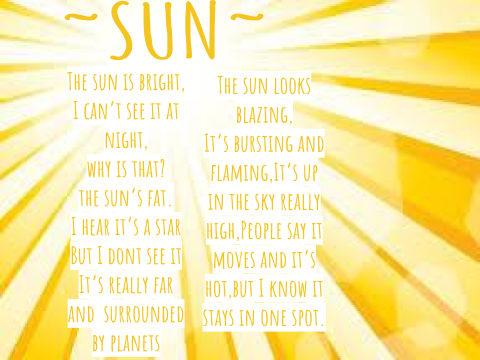

WALT create an sun poem
Today I have created my very own sun poem.I have did an acrostic poem to help me describe the sun.I found it kind of tricky because how the sun is very far.
I hope you enjoyed learning about the sun...THANKYOU

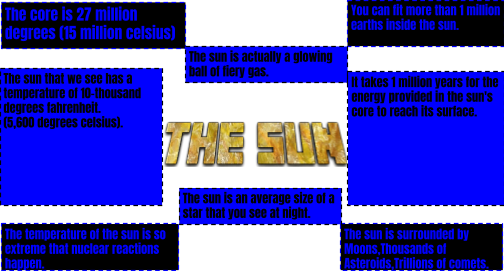
Today we where learning about the sun and here is a little drawing of facts about the sun.
WALT: Connect to the topic (Earth and Beyond) and Rhyme.
Today in class I decide to make a poem on the sun, I enjoy rhyming so why not!WALT create an sun poem
Today I have created my very own sun poem.I have did an acrostic poem to help me describe the sun.I found it kind of tricky because how the sun is very far.
I hope you enjoyed learning about the sun...THANKYOU
Wednesday, 14 October 2015
Activating Prior Knowledge in Room 6
Term 4 has started with a rush and a roar, or rather a countdown and a blast off! This term for Inquiry we are investigating the Earth and Beyond, the Final Frontier, and began the unit by activating our prior knowledge. It's always a good idea to start with what you know. By discussing ideas and concepts (and misconceptions) that we already know about Space, we can identify areas we need to investigate further and make connections with new knowledge.
 Mrs Manuyag did an awesome art lesson on the first day back as part of the Inquiry Unit's big reveal. The students created representations of our solar system, with planets, the Sun, and an asteroid belt using inspiration from the Mandala art technique.

A common way that we get the students talking and thinking about a new topic is by completing a bus stop activity. Miss Aireen and I came up with questions that related to the topic, eg. What words do we know that are associated with Space?
Students are organised into small groups and start off at one of the bus stop questions. Before the activity started we had a rousing whole class discussion to get the brain juices flowing before setting off for quick fire stops. Students had around 2mins at each question to jot down their ideas.
Once all the groups had answered each of the questions we had a feedback session where groups identified the top 5 answers on their sheet. I recorded these ideas on a class presentation for the students to refer to and add to as a follow up activity. The feedback session generated some more interesting discussion and I can already tell this Inquiry topic is really going to generate some great questioning and debate amongst the students.


Students are organised into small groups and start off at one of the bus stop questions. Before the activity started we had a rousing whole class discussion to get the brain juices flowing before setting off for quick fire stops. Students had around 2mins at each question to jot down their ideas.
Once all the groups had answered each of the questions we had a feedback session where groups identified the top 5 answers on their sheet. I recorded these ideas on a class presentation for the students to refer to and add to as a follow up activity. The feedback session generated some more interesting discussion and I can already tell this Inquiry topic is really going to generate some great questioning and debate amongst the students.
Onwards and Upwards - To Infinity and Beyond!
Oh and yes we have already had lots of giggles when mentioning the 7th planet in our Solar System, whoever named Uranus has a lot to answer for!
Oh and yes we have already had lots of giggles when mentioning the 7th planet in our Solar System, whoever named Uranus has a lot to answer for!
Subscribe to:
Comments (Atom)